
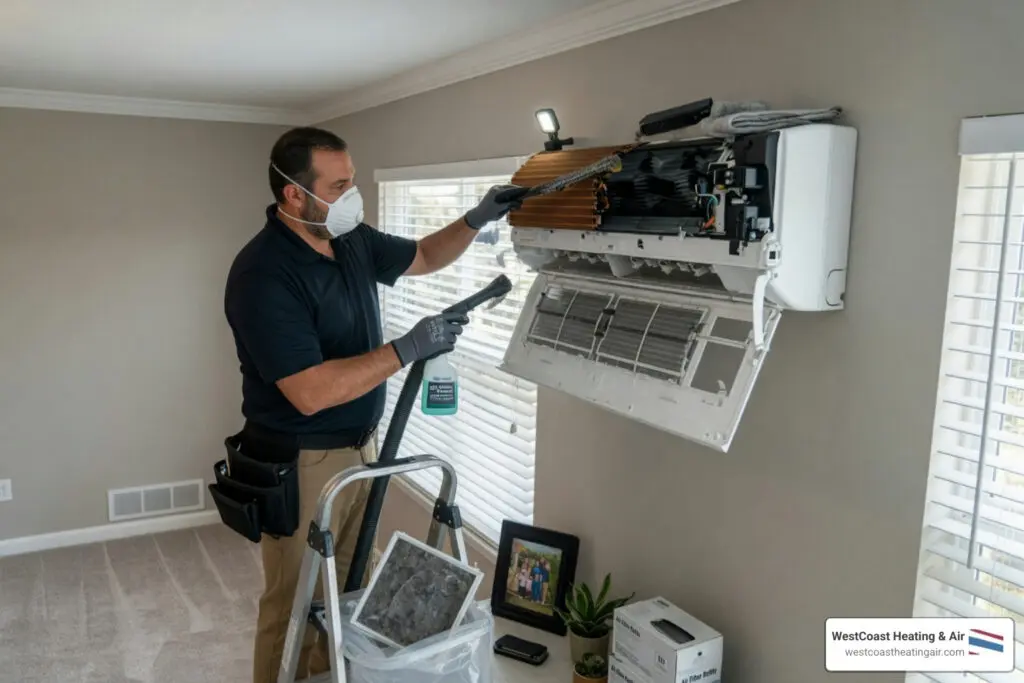
Why Knowing How Proper HVAC Maintenance Prevents Mold Growth Could Protect Your Puyallup Home
How proper HVAC maintenance prevents mold growth comes down to one core principle: controlling moisture before mold ever gets a foothold.
Here’s a quick summary of how HVAC maintenance keeps mold at bay:
- Change air filters every 30–90 days to prevent restricted airflow and frozen coils
- Clean condensate drain lines regularly to stop standing water from forming
- Keep indoor humidity between 30–50% using your AC, a hygrometer, and if needed, a whole-home dehumidifier
- Schedule professional tune-ups twice a year — spring and fall — so coils, drain pans, and ductwork stay clean and dry
- Seal leaky ductwork to stop humid attic or crawlspace air from sneaking into your system
- Consider UV-C lights near the evaporator coil to continuously sterilize mold spores before they spread
Mold spores are always in the air around us — they’re too small to see and impossible to fully eliminate. The only thing keeping them dormant is a dry environment. When your HVAC system develops moisture problems — whether from a clogged drain, a dirty filter, or leaky ducts — it stops being a defense against mold and starts becoming a breeding ground for it. According to a 2004 study, roughly 20% of buildings across the US, Canada, and Europe already show signs of dampness, much of which traces back to HVAC issues that routine maintenance could have prevented.
For Pacific Northwest homeowners, this isn’t a distant concern. Washington’s damp, rainy climate means your HVAC system is working against higher baseline humidity levels year-round, making consistent maintenance more important here than in drier parts of the country.
I’m Michael Smith, owner of WestCoast Heating & Air in Puyallup, and after decades of hands-on problem-solving — first at Boeing and now serving local families with their heating and cooling needs — I’ve seen how how proper HVAC maintenance prevents mold growth is one of the most important things a homeowner in this region can understand. Let’s walk through exactly what causes mold to form in HVAC systems, and what you can do to stop it.
Why HVAC Systems Become Mold Hotspots
HVAC systems can accidentally create the exact conditions mold likes best: moisture, dust, darkness, and limited airflow.
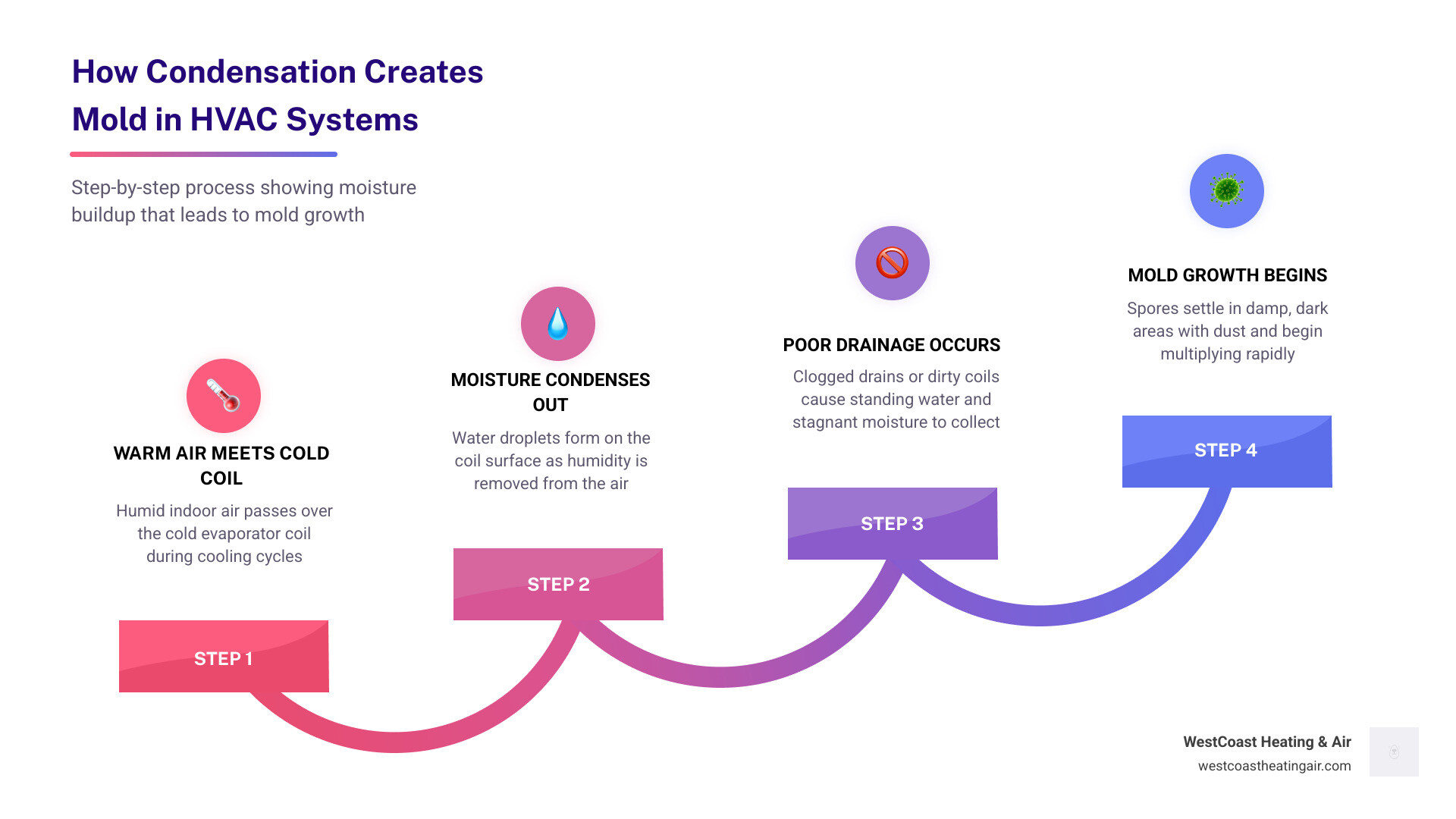
Inside a typical home system, the evaporator coil gets cold during cooling cycles. Warm indoor air passes over that cold coil, and moisture condenses out of the air. That is normal and necessary. It is part of how air conditioning lowers indoor humidity. The problem starts when that moisture does not drain properly, when dust builds up on surfaces, or when humid air sneaks into places it should not.
Mold often starts in hidden areas homeowners never see, including:
- Evaporator coils
- Condensate pans
- Condensate drain lines
- Blower compartments
- Dirty filters
- Supply and return ducts
- Uninsulated duct sections in attics or crawlspaces
Because these spaces stay dark and can remain damp, mold can grow quietly before anyone notices. Often the first clue is not visible mold at all. It is a musty smell when the AC starts, or allergy symptoms that seem worse at home than anywhere else.
The root cause: how proper hvac maintenance prevents mold growth starts with moisture control
If there is one rule that matters most, it is this: mold needs moisture.
Research consistently shows mold flourishes when relative humidity rises above 60%. EPA guidance recommends keeping indoor humidity in the 30% to 50% range for comfort and mold prevention. In that range, spores are much less likely to wake up, settle, and colonize damp surfaces.
That is why how proper HVAC maintenance prevents mold growth is really a humidity-control story. Your HVAC system should be removing moisture, moving air, and draining condensation away. When it cannot do those jobs well, humidity creeps up and mold gets an opening.
For homeowners in Puyallup, Tacoma, Sumner, Spanaway, SeaTac, University Place, Tumwater, Roy, Orting, and nearby areas, this matters even more during wet weather and those in-between seasons when outdoor air feels cool but still carries a lot of moisture.
Why the evaporator coil and drain pan are common mold breeding areas
The evaporator coil is one of the most common mold hotspots in any AC system. It is cold, it gets wet during operation, and it collects dust over time. Dust becomes food. Condensation becomes water. Mold calls that a great day.
Just below the coil is the drain pan, which is supposed to catch condensation and send it out through the condensate line. If the pan is dirty, sloped poorly, or connected to a clogged drain line, water can sit there instead of draining away. Once standing water mixes with dust and biofilm, mold and slime can start to grow.

A neglected drain pan is one of those humble little problems that can turn into a big one. It is not glamorous, but it matters.
How mold gets into ducts and spreads through the house
Mold spores are already in the air. Your HVAC system does not create spores from thin air, but it can pull them in and move them around.
Leaky return ducts can draw humid, dusty air from attics, crawlspaces, or wall cavities. If that air hits cool duct surfaces, condensation can form. Spores then land on damp dust inside the duct and begin to grow. From there, the system can circulate musty odors and airborne irritants through supply vents into multiple rooms.
That is why homeowners often notice:
- Musty or earthy smells when the system starts
- Dark spots around vent covers
- Uneven humidity from room to room
- More sneezing, coughing, or irritated eyes indoors
The Main HVAC Problems That Cause Mold in Homes
Most HVAC mold problems come back to a short list of troublemakers:
- Clogged condensate drains
- Dirty air filters
- Leaky ductwork
- Poor duct insulation
- Blocked vents or closed registers
- Oversized AC systems that short cycle
- Infrequent maintenance
None of these issues sounds dramatic on its own. Together, they can turn your HVAC system into a damp little science project.
How clogged drains, dirty filters, and leaky ducts contribute to mold
Here is how the most common maintenance problems create mold risk:
| HVAC problem | What it does | Why mold risk goes up |
|---|---|---|
| Clogged drain line or pan | Traps condensate and creates standing water | Mold grows on wet surfaces and sludge |
| Dirty air filter | Restricts airflow and loads system with dust | Coils can get too cold, freeze, then thaw and create extra moisture |
| Leaky ducts | Pulls in humid air from unconditioned spaces | Moisture condenses inside ducts and feeds mold on dust |
Dirty filters are especially sneaky. A damp, dusty filter is basically a snack tray for mold. On top of that, airflow restriction can cause the evaporator coil to get too cold. That can lead to ice buildup, and when that ice melts, you can end up with more water than the drain system can handle.
Leaky ducts create a different kind of problem. In many Washington homes, attic or crawlspace air is cooler than summer air but still damp. When that moisture enters the duct system, it can create sweating on duct surfaces or hidden condensation deeper inside the run.
Why oversized or poorly running AC systems fail to dehumidify
A lot of homeowners assume bigger AC always means better comfort. Unfortunately, that is not how dehumidification works.
An oversized AC cools the house too quickly and shuts off before it has enough runtime to remove much moisture. That is called short cycling. The home may feel cool, but it also feels clammy. And clammy homes are mold-friendly homes.
A properly sized system runs long enough to remove both heat and humidity. If the unit is oversized, poorly tuned, or cycling irregularly, it may never maintain healthy humidity levels even if the thermostat reading looks fine.
This is one reason customized system design matters. It is also why we take sizing and airflow seriously instead of treating every house the same.
Hidden moisture issues homeowners often miss
Some mold risks are not obvious until damage is already underway. Common hidden issues include:
- Uninsulated ducts that sweat in attics, garages, or crawlspaces
- Furniture blocking supply or return vents
- Closed registers that disrupt pressure balance
- Bathroom humidity lingering after showers
- Laundry room moisture from dryers or damp clothes
- Small roof or plumbing leaks near duct runs or air handlers
Even your thermostat settings can play a role. In many homes, using the fan in the “On” position instead of “Auto” can keep moving moisture off the wet coil and back into the air before it drains away. “Auto” often does a better job letting the coil drain and dry between cycles.
How Proper HVAC Maintenance Prevents Mold Growth Year-Round
Routine care is what keeps normal condensation from becoming a mold problem in residential HVAC systems. If you want the full picture on maintenance timing, see How Often Should You Schedule an HVAC Tune-Up and What Happens If You Skip HVAC Maintenance.
The maintenance habits that matter most for mold prevention
The most effective mold-prevention habits are simple, consistent, and boring in the best possible way:
- Change filters every 30 to 90 days, depending on filter type, pets, dust load, and system use
- Keep supply and return vents open and unobstructed
- Check the drain pan for standing water
- Flush or inspect the condensate drain line regularly
- Have evaporator coils cleaned when dirty
- Schedule professional HVAC tune-ups twice a year
- Inspect ductwork for leaks, loose connections, and missing insulation
Monthly homeowner mold-prevention checks:
- Look for water near the indoor unit
- Sniff for musty odors when the system starts
- Check one or two vents for dust buildup or discoloration
- Confirm vents are not blocked by rugs, furniture, or curtains
- Check your humidity reading with a hygrometer
- Replace the filter if it looks dirty or if it is due
These small habits make a big difference. Mold loves neglect, not attention.
How proper hvac maintenance prevents mold growth by keeping humidity between 30% and 50%
Humidity control is the centerpiece of prevention.
The best target for most homes is 30% to 50% relative humidity. Once indoor humidity stays above 60%, mold becomes far more likely to grow on dust, drywall, vents, insulation, and HVAC components.
A few smart ways to keep humidity in range:
- Use a simple hygrometer to monitor indoor humidity
- Run your AC during warmer humid weather so it can dehumidify
- Use bathroom fans during showers and for about 20 minutes afterward
- Use kitchen exhaust fans while cooking
- Dry wet materials quickly, ideally within 24 to 48 hours
- Consider a whole-home dehumidifier if your AC alone cannot keep up
If your home regularly feels sticky, smells musty, or fogs windows during mild weather, that is your house waving a damp little red flag.
Best filter, airflow, and ductwork practices for cleaner, drier air
Good airflow helps moisture leave the system instead of lingering in it.
For most homes, filters in the MERV 8 to 13 range provide a strong balance of filtration and airflow when matched to the system. The exact filter should always fit the equipment’s design. Too restrictive is not automatically better.
For mold prevention, we recommend focusing on these basics:
- Use the right filter size and rating for your system
- Replace filters on schedule
- Keep all main vents and returns clear
- Do not close off multiple rooms to “save energy”
- Seal leaky ductwork
- Insulate ducts in unconditioned spaces
For more on this, read The Importance of Seasonal Filter Changes & Airflow Optimization and Maintenance Secrets to Keep Your HVAC Running Smoothly.
Smart add-ons that help prevent mold on coils and in damp systems
Some homes benefit from extra tools, especially in damp climates or homes with persistent humidity issues.
UV-C lights are commonly installed near the evaporator coil. Their job is to disrupt microbial growth on coil surfaces where condensation is common. They are not magic and they do not replace maintenance, but they can be very helpful in the right application.
Whole-home dehumidifiers are another strong option when standard AC cannot keep humidity in the safe range. They are especially useful during shoulder seasons when outdoor air is damp but cooling demand is low.
Other helpful upgrades may include:
- Smart thermostats or controls with humidity tracking
- Indoor air quality accessories designed for moisture-sensitive homes
- Air scrubber systems in the right residential setup
If you are curious about these options, How Do UV Air Scrubbers Work and Should You Get One for Your Pierce County Home? is a good next read.
Signs Your HVAC System May Already Have Mold
Mold in HVAC systems is often hidden, but the warning signs are not always subtle.
Early warning signs homeowners notice first
The earliest clues usually include:
- A musty, earthy, or damp smell when the AC starts
- Visible spotting on vent covers or around registers
- Water stains near the indoor unit
- Excess condensation on ducts or equipment
- Air that feels sticky or stale
Musty odor at startup is one of the most common clues because mold produces microbial compounds that create that unmistakable “old basement” smell. If your home suddenly smells like a gym bag every time the system turns on, do not ignore it.
Health and indoor air quality symptoms linked to HVAC mold
Mold in the system can affect indoor air quality and aggravate health symptoms, especially for children, older adults, and people with allergies or asthma.
Symptoms may include:
- Sneezing
- Coughing
- Itchy or watery eyes
- Headaches
- Throat irritation
- Worsening asthma symptoms
- Feeling better after leaving the house
For more on HVAC and indoor air quality, see Exploring the HVAC System and Germs Connection in Puyallup.
When to call a professional for HVAC mold issues
Homeowners should call a professional when:
- Mold is visible on HVAC components
- Musty odors keep returning after filter changes
- Drain pans keep filling with water
- Duct insulation is wet or soaked
- There is visible contamination inside ductwork
- Allergy symptoms spike when the system runs
- The affected mold area is larger than about 10 square feet
That last point matters because EPA guidance generally recommends professional help for larger mold problems. Also, if mold is inside the coil cabinet, blower section, or duct system, the real issue is not just cleanup. It is finding and fixing the moisture source so the mold does not come right back.
Seasonal Mold Prevention Tips for Homes in Wet Climates
In our part of Washington, mold prevention is not just a summer issue. Rain, cool damp air, and shoulder-season humidity can all create trouble.
Wet-weather HVAC habits that help prevent mold in Washington homes
A few habits go a long way in our local climate:
- Run your AC during warmer humid periods to remove moisture
- Use bathroom exhaust fans every time you shower
- Use the kitchen hood when boiling or steaming
- Keep interior airflow moving by leaving vents open
- Dry spills, leaks, or damp materials quickly
- Check around windows, crawlspaces, and utility areas for hidden moisture
For more local guidance, visit Keeping the Mold Away: HVAC Maintenance for Rainy Regions.
A simple seasonal schedule to keep your system mold-resistant
Here is a practical schedule homeowners can follow:
Spring:
- Schedule AC tune-up
- Inspect evaporator coil and drain system
- Replace filter
- Check indoor humidity as weather warms
Summer:
- Monitor humidity regularly
- Keep outdoor unit clear of debris
- Watch for musty smells or water around the air handler
- Use exhaust fans to control indoor moisture
Fall:
- Schedule heating-season maintenance
- Replace filter
- Inspect ductwork and insulation
- Address any lingering moisture issues before winter
Winter:
- Keep an eye on condensation near windows and vents
- Use bath and kitchen ventilation consistently
- Check crawlspaces or utility areas for dampness
- Continue monthly filter and humidity checks
Frequently Asked Questions About How Proper HVAC Maintenance Prevents Mold Growth
What humidity level prevents mold in an HVAC system?
The best target is 30% to 50% relative humidity. Mold becomes much more likely once humidity rises above 60%. A simple hygrometer can help you keep tabs on indoor moisture before it becomes a problem.
Can a dirty filter really cause mold growth?
Yes. A dirty filter can trap dust and organic debris, which mold can feed on if the filter becomes damp. It also restricts airflow, which can lead to coil freezing, thawing, and excess moisture in the system. Small filter, big attitude.
Should I clean HVAC mold myself or call a professional?
If you see a tiny amount of surface dust or grime on a vent cover, you may be able to clean the cover itself safely. But if you suspect mold inside ductwork, on coils, in the air handler, or around insulation, call a professional. HVAC mold problems usually involve hidden moisture, and cleaning the visible part without fixing the cause rarely solves the problem.
Conclusion
Preventing mold is really about helping your HVAC system do its job: move air, remove moisture, and stay clean. When filters are changed on time, drains stay clear, coils stay clean, and ducts stay sealed, your home has a much better chance of staying dry, healthy, and comfortable year-round.
That is the real answer to how proper HVAC maintenance prevents mold growth. It protects indoor air quality, supports better health, reduces system strain, and helps you avoid the kind of hidden moisture problems that can spiral into bigger repairs.
If you want help improving humidity control and cleaner indoor air in your home, learn more about our indoor air quality services. You can also explore related tips like How to Prevent Furnace Carbon Monoxide Problems to keep your whole home comfort system safer and healthier.