

Why How HVAC Condition Affects Home Appraisals Matters More Than Most Homeowners Realize
How HVAC condition affects home appraisals is one of the most overlooked factors when homeowners prepare to sell, refinance, or tap into their equity through a HELOC — and the financial stakes are very real.
Here is a quick summary of how HVAC condition affects appraised value:
| HVAC Situation | Typical Appraisal Impact |
|---|---|
| Aging or failing system (15–25 years old) | $5,000–$10,000 value reduction |
| Missing central air in a market where it is expected | $5,000–$8,000 value penalty |
| New or upgraded system installed | 5%–7% increase in appraised value |
| Typical cost recovery from HVAC replacement | 40%–60% of installation cost |
| High-efficiency system (SEER2 18+, AFUE 95%+) | Up to 50%–80% ROI in added value |
Your HVAC system is evaluated right alongside your roof, foundation, and electrical work. Appraisers place it squarely in the “physical condition” category of a home — meaning a system that is aging, non-functional, or simply missing where buyers expect it can trigger real dollar deductions in your appraisal report. On the flip side, a well-maintained or recently upgraded system can protect your equity, smooth out the financing process, and even give you a small competitive edge in the comparable sales analysis.
What surprises most homeowners is how much maintenance history and documentation matter, not just the age of the equipment itself. A well-kept 18-year-old system documented with service records will often fare better in an appraisal than a neglected 12-year-old unit with no paper trail.
I’m Michael Smith, owner of WestCoast Heating & Air in Puyallup, Washington, and after more than 30 years in technical problem-solving — including a long career at Boeing — I have seen how understanding how HVAC condition affects home appraisals can mean the difference between protecting your equity and losing thousands on paper. In this guide, I will walk you through exactly what appraisers look for, what red flags to avoid, and how to make smart decisions about your system before your next appraisal.
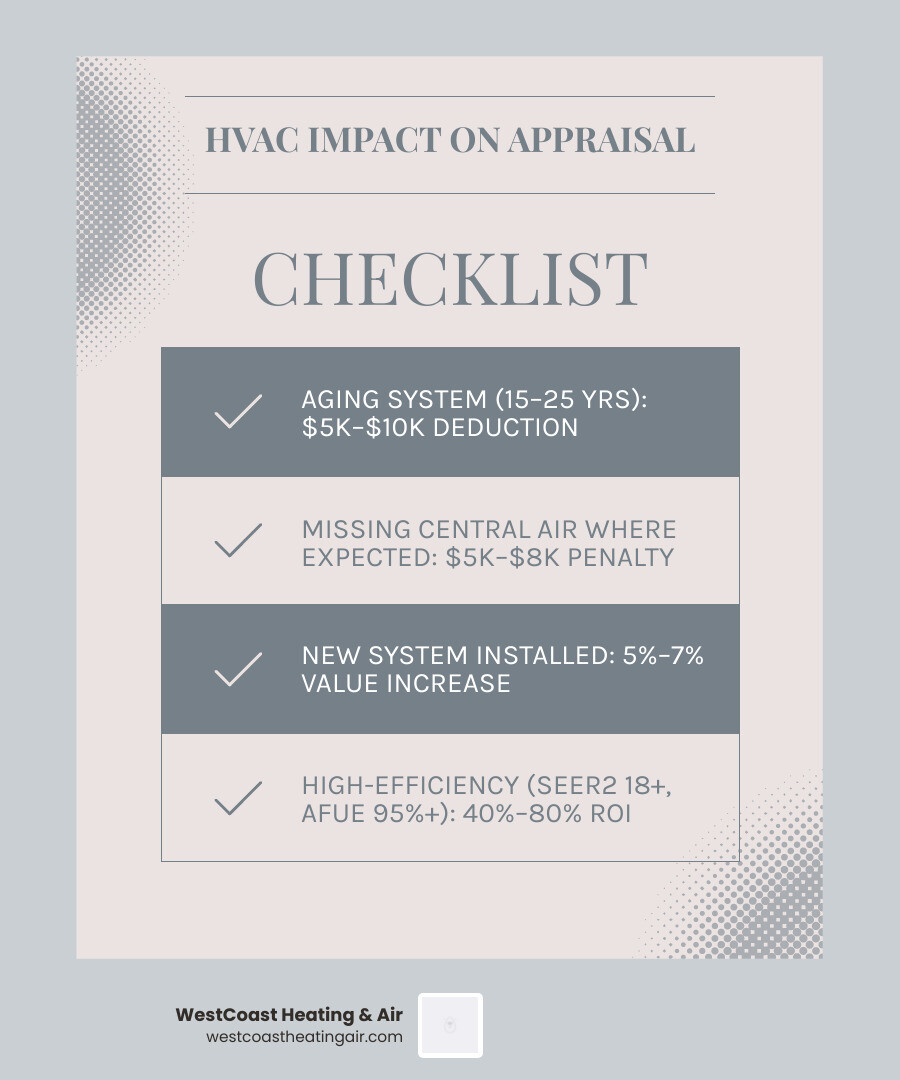
How HVAC Condition Affects Home Appraisals
In simple terms, appraisers are trying to answer one question: how will your heating and cooling system affect the home’s value compared with similar homes nearby?
They usually look at HVAC through a few practical lenses:
- Age of the equipment
- Whether it appears to work properly
- Remaining useful life
- Visible condition
- Whether the system matches buyer expectations in the local market
- Whether any issues suggest deferred maintenance
Most residential systems have an expected lifespan of about 15 to 25 years. That does not mean a 16-year-old system automatically tanks your appraisal. It does mean age starts attracting attention, especially once the system moves into the 15-to-20-year range.
Why HVAC matters in an appraiser’s overall condition rating
HVAC is not treated like a decorative upgrade. It is part of the home’s basic livability.
A home can have beautiful flooring and a kitchen worthy of its own zip code, but if the heat is unreliable or the AC is on its last legs, appraisers and lenders notice. HVAC affects:
- Habitability
- Year-round comfort
- Buyer confidence
- Overall property condition
- Refinance and lending risk
In many appraisal reports, HVAC is folded into the broader “condition” rating rather than getting its own flashy scorecard. That means a bad system can drag down the home’s overall impression.
How hvac condition affects home appraisals in buyer-expected markets
In Western Washington communities like Puyallup, Tacoma, University Place, Sumner, and surrounding areas, buyer expectations matter a lot. Appraisers compare your home to what nearby buyers expect in your price range and neighborhood.
If similar homes have dependable heating and cooling and yours does not, your home may be seen as functionally behind the market. That gap can lead to a value penalty.
A common example is missing central air where comparable homes have it. In markets where cooling has become a normal expectation rather than a luxury, research shows the penalty can be around $5,000 to $8,000. In appraisal language, that is often tied to marketability and functional obsolescence. In normal language, it means buyers see a project they will need to handle after closing.
How appraisers actually evaluate heating and cooling systems
Appraisers are not doing a full HVAC diagnostic. They are not measuring refrigerant charge or pulling blower assemblies apart. But they do make practical observations that matter.
They may check:
- Manufacturer labels for model and approximate production date
- Visible install date stickers or permit tags
- Whether the thermostat responds
- Whether the system turns on during the visit
- Basic airflow at supply vents
- Signs of rust, leaks, corrosion, or neglect
- Whether access is clear around the equipment
If the unit looks old, dirty, noisy, or obviously compromised, that can influence the report even without a technical failure test.

What Appraisers Look for: Key Factors, Red Flags, and Documentation
Age alone does not decide value. Condition tells the real story.
A clean, documented system with regular service history gives an appraiser more confidence than one with mystery stains, a clogged filter, and the mechanical equivalent of a wheezing cough.
The biggest HVAC red flags that can trigger value penalties
These are the issues most likely to raise eyebrows and invite downward adjustments or condition comments:
- Rust or corrosion on the furnace, coil cabinet, or drain pan
- Refrigerant leaks or oily residue near AC components
- Systems that use R-22 refrigerant
- Short cycling
- Unusual noises like screeching, banging, or rattling
- Uneven temperatures from room to room
- Dirty filters and visibly neglected vents
- Condensate stains or water damage near the air handler
- Damaged, disconnected, or crushed ductwork
- A furnace or AC that does not operate during the appraisal
- Blocked access to the indoor or outdoor unit
R-22 is a particularly important red flag because it usually signals an aging cooling system with more difficult and expensive repair considerations. If an appraiser sees an older R-22-era unit, they may reasonably assume limited remaining life.
How maintenance history shapes appraiser confidence
Maintenance history helps establish the system’s “effective age,” which is often more important than the birthday on the data plate.
A well-maintained system may still be older, but it looks cared for, performs better, and feels less risky to a buyer or lender. That matters.
Helpful records include:
- Annual tune-up receipts
- Repair invoices
- Filter replacement logs
- Notes about parts replaced
- Duct cleaning or sealing records
- Inspection reports
If you want to tighten up your maintenance record before an appraisal, these resources can help:
- Maintenance Secrets to Keep Your HVAC Running Smoothly
- What Happens If You Skip HVAC Maintenance
- How Often Should You Schedule an HVAC Tune-Up
What documentation homeowners should hand to the appraiser
We recommend building a simple HVAC folder before the appraisal. Think of it as a paper trail for your comfort system.
Include:
- Paid installation invoices
- Permit records and final inspection sign-offs
- Warranty paperwork
- Model and serial numbers
- Efficiency information such as SEER2, AFUE, or HSPF2
- ENERGY STAR details if applicable
- Service and maintenance logs
- Before-and-after photos for recent upgrades
- Any inspection report showing the system is operational
This does not force an appraiser to assign extra value, but it absolutely helps them understand what was upgraded and why it matters.
The Real Value Impact of Old, Missing, or Upgraded HVAC
Here is the honest version: HVAC upgrades usually protect value more than they create dramatic new value.
That may not sound exciting, but protecting value is often the difference between a smooth appraisal and a painful one.
Typical appraisal impact of aging or failing systems
Once a system reaches the 15-to-20-year range, appraisers start looking more closely at its remaining life. Around 25 years, the concern becomes much stronger.
Research consistently points to these common outcomes:
- Aging or failing HVAC can reduce appraised value by $5,000 to $10,000 or more
- A 25-year-old furnace may trigger a downward adjustment of roughly $3,000 to $6,000
- Systems over 15 to 20 years old are more likely to be flagged as deferred maintenance
Even when the exact adjustment is not itemized as “HVAC minus this much,” it still affects the overall condition rating and the comparable sales analysis.
How much value a new HVAC system can realistically recover
A new system can help in three ways:
- It removes a major objection
- It helps the home compare better against nearby sales
- It supports a stronger condition rating
Most homeowners should expect HVAC replacement to recover roughly 40% to 60% of its cost in immediate appraised value. In some situations, especially when replacing a clearly failing system or bringing the home up to neighborhood expectations, the return may be stronger.
Some sources estimate a 5% to 7% increase in appraised value after installing a new or upgraded system, but that is usually the high end and depends heavily on the home, market, and what comparable properties offer. In many cases, the real benefit is avoiding the penalty attached to old or failing equipment.
How efficiency ratings like SEER2 and AFUE influence valuation
Efficiency ratings do not usually produce huge standalone appraisal bumps, but they can support a positive marketability story.
The ratings homeowners should know are:
- SEER2 for cooling efficiency
- AFUE for furnace heating efficiency
- HSPF2 for heat pump heating performance
High-efficiency systems, especially those with SEER2 ratings on the stronger end and furnaces with AFUE of 95% or higher, may help support a modest premium. Research suggests high-efficiency systems can deliver 50% to 80% ROI in added value in the right circumstances.
Why? Because buyers and appraisers understand that higher efficiency can mean:
- Lower utility bills
- Better comfort
- More modern equipment
- Longer remaining useful life
- Better alignment with current buyer expectations
If you are exploring upgrade paths, these reads are useful:
- The Best High Efficiency Heating Options for Your Home
- Advantages of Upgrading to a High Efficiency Heat Pump
- Comparing the Cost and Comfort of Modern HVAC Systems
How hvac condition affects home appraisals when central air is missing
This is one of the clearest examples of market expectations driving value.
If most comparable homes in your area have central cooling and yours does not, appraisers may treat that as a meaningful functional gap. Research commonly puts the value penalty in the $5,000 to $8,000 range where central air is expected.
That does not mean every home without central air gets punished the same way. It depends on:
- The neighborhood standard
- The home’s price point
- The age and style of the home
- What nearby comparable sales offer
If you are retrofitting an older home to better match market expectations, Teaching an Old House New Tricks: Retrofitting HVAC is a smart next step.
HELOC and Refinance Appraisals: Protecting Equity and Borrowing Power
For HELOCs and refinances, the HVAC story gets even more practical.
The appraised value affects your available equity. Your available equity affects how much you may be able to borrow. So if HVAC issues drag the value down, they can shrink your borrowing room.
How hvac condition affects home appraisals for HELOCs and refinances
In a refinance or HELOC appraisal, the appraiser is still valuing the property, but lenders are especially sensitive to condition issues that suggest risk.
A worn-out or non-functional HVAC system can lead to:
- A lower appraised value
- More conservative underwriting
- Condition comments in the appraisal report
- Questions about deferred maintenance
- Reduced loan-to-value flexibility
In other words, a tired HVAC system may not directly “deny” your application, but it can absolutely squeeze the value side of the equation.
Can a broken or outdated system reduce borrowing limits?
Yes, it can.
If the system is broken, visibly failing, or near the end of its useful life, the lender may view the property as riskier collateral. That can reduce borrowing limits by lowering the appraised value or creating conditions that need to be addressed before closing.
Functional heat is especially important. For some loan situations, a home without a dependable heat source can trigger major underwriting concerns. Cooling matters too when it is part of normal buyer and market expectations.
Is servicing or replacing HVAC before a HELOC appraisal worth it?
Often, yes, but the answer depends on the condition of the system.
A pre-appraisal service visit is usually worthwhile if your system is basically sound but needs cleanup, a fresh filter, or proof that it is operating correctly. Servicing can help demonstrate visible care and may reduce the chance of a negative impression.
Replacement makes more sense if the system is:
- Near end of life
- Frequently breaking down
- Using outdated refrigerant
- Clearly underperforming
- Mismatched with the home’s market position
If you are unsure whether your system is still worth defending, start here:
- Signs It’s Time to Upgrade Your HVAC System
- What to Expect During an HVAC Replacement
Should You Replace the HVAC Before an Appraisal?
This is the question homeowners really want answered, and the honest answer is: sometimes yes, sometimes absolutely not.
When replacement makes financial sense before an appraisal
Replacement is often the smarter move when:
- The system is 20 to 25 years old
- Repairs are becoming frequent
- The AC uses R-22 refrigerant
- The furnace or heat pump is unreliable
- Your home is otherwise in very good condition and the HVAC stands out as a weakness
- Comparable homes in your neighborhood have modern heating and cooling
- Your home lacks central cooling where buyers expect it
In those situations, replacement is often less about “adding value” and more about removing a known liability.
When waiting may be the better move
Waiting can make sense when:
- The system is midlife and working well
- You have strong maintenance records
- The equipment is clean, quiet, and performs properly
- Your home needs other updates that matter more to market value
- The surrounding market does not strongly reward premium HVAC upgrades
A 10-year-old to 15-year-old system in good condition usually does not need to panic-buy its retirement gift.
Best pre-appraisal steps if you are not replacing the system
If you plan to keep the current system, do these basics before the appraisal:
- Change the air filter
- Clean supply and return vents
- Clear debris around the outdoor unit
- Test the thermostat
- Make sure the system turns on normally
- Gather service records and receipts
- Fix obvious minor issues like rattling panels or blocked access
Here is a simple comparison:
| Option | Best for | Main goal |
|---|---|---|
| Replace now | End-of-life, failing, outdated, or missing system | Eliminate value penalty and improve marketability |
| Service and document | Midlife, functional, maintained system | Support condition rating and avoid unnecessary deductions |
Frequently Asked Questions About How HVAC Condition Affects Home Appraisals
How old does HVAC need to be before it hurts an appraisal?
Usually, the concern starts building around 15 to 20 years. Systems under 10 years old are generally viewed more favorably. But age alone is not everything. A well-maintained older system can outperform a neglected newer one in appraisal terms because condition and remaining useful life matter more than raw age.
Will a new HVAC system dramatically raise appraised value?
Usually not dramatically. A new system is more likely to protect value than create a huge jump. Many homeowners recover around 40% to 60% of the upgrade through appraised value, and in some cases more. The bigger win is often avoiding a lower appraisal caused by deferred maintenance or obsolete equipment.
Can smart controls or efficiency upgrades help even if I keep my current system?
Yes, within reason.
Smart thermostats, zoning improvements, and documented efficiency upgrades can improve marketability and show that the home is updated. They usually will not add a massive amount on their own, but they can support buyer confidence and help the system present better as part of the home’s overall condition package.
Conclusion
At the end of the day, how HVAC condition affects home appraisals comes down to risk, expectations, and documentation. Appraisers want to know whether your heating and cooling system supports the home’s value or threatens it.
For homeowners in Puyallup, Tacoma, Sumner, Tumwater, SeaTac, Spanaway, University Place, Steilacoom, Roy, and Orting, the smartest strategy is usually pretty simple:
- Keep the system maintained
- Save the paperwork
- Fix obvious red flags
- Replace equipment when it has truly become a liability
That approach protects your equity whether you are selling, refinancing, or applying for a HELOC.
If you want help getting your home ready for an appraisal, we are here to help with practical guidance, clear recommendations, and customized residential solutions. Learn more about our residential heating and cooling services.